 Cold Email
55 Best Cold Email Subject Lines That Get Opens in 2026 (With Data)
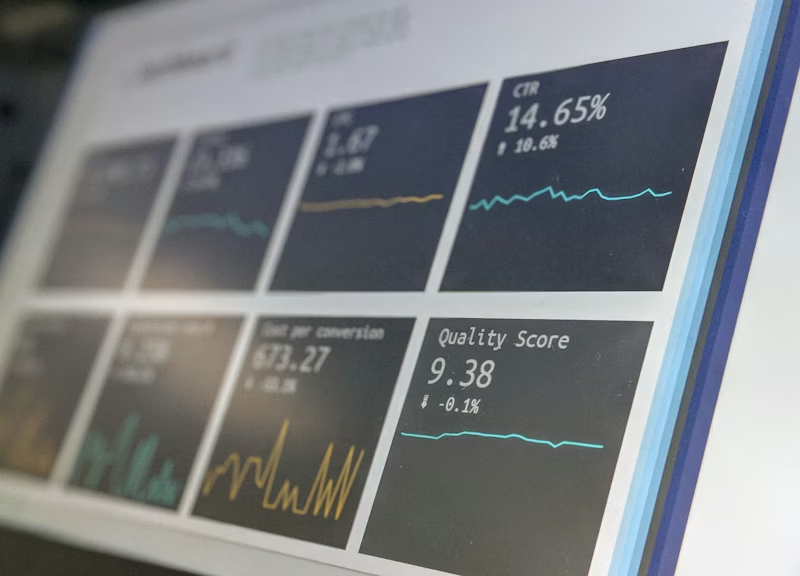
The average cold email open rate in 2026 is 44%, but the range across campaigns is enormous — from under 15% for generic blasts to over 65% for tightly targeted, well-structured outreach. (Source: Saleshandy, 2026) Subject lines account for a disproportionate share of that variance. In controlled tests across millions of emails, subject line optimization alone lifts open rates by 20-49%. (Source: Instantly, 2025) The 55 subject lines below are organized by strategy, grounded in current performance data, and annotated with the psychology behind why each category works.
The Data Behind High-Performing Subject Lines
Before the examples, the benchmarks. Subject lines between 21 and 40 characters achieve the highest average open rate at 49.1%. (Source: Mailpool, 2026) Subject lines under 5 words outperform longer alternatives by 25%. (Source: Instantly, 2025) Question-format subject lines average 46% open rates versus 35% for statement formats — a 31% lift from format alone. (Source: Belkins, 2025) Personalized subject lines that reference a company name, recent event, or role-specific detail achieve 46% open rates compared to 35% for generic alternatives. (Source: Saleshandy, 2025) You can score any line against these benchmarks in the free cold email subject line tester, which also previews how it truncates on a phone.
| Subject Line Characteristic | Avg. Open Rate | vs. Baseline | Source |
|---|---|---|---|
| 21–40 characters | 49.1% | +12pp vs. 60+ chars | Mailpool, 2026 |
| Under 5 words | 46% | +25% relative lift | Instantly, 2025 |
| Question format | 46% | +31% vs. statement | Belkins, 2025 |
| Personalized (company/event/role) | 46% | +31% vs. generic | Saleshandy, 2025 |
| Statement format (no question) | 35% | Baseline | Belkins, 2025 |
| Number included in subject | 27% | Slightly below baseline | Belkins, 2025 |
| Urgency/hype language cluster | Below 36% | Negative vs. baseline | Instantly, 2025 |
| ALL CAPS anywhere in subject | Below 30% | Negative — filter risk | Folderly, 2025 |
Category 1: Question-Format Subject Lines (Avg. Open Rate: 46%)
Questions create an open loop in the reader's mind. They imply a two-way conversation rather than a broadcast and suggest that the sender expects a specific response. Questions work best when they are genuinely relevant to the prospect's role and situation — not rhetorical marketing questions dressed up as curiosity. The highest-performing questions in this category are role-specific and reference a concrete situation rather than a generic aspiration.
- 'Quick question about [Company]'s outbound strategy'
- 'Are you the right person to talk about [specific function]?'
- 'Is [known pain point] on your radar for Q2?'
- 'How is [Company] currently handling [specific process]?'
- 'Would [specific result] be useful for your team right now?'
- 'Are you open to a different approach to [problem]?'
- 'Have you tried [specific method] for [goal] yet?'
- 'What's your team's current approach to [specific challenge]?'
- 'Is [relevant metric] something you track at [Company]?'
- 'Would it make sense to connect on [specific topic]?'
Category 2: Trigger-Event and Research-Based Subject Lines
Subject lines that reference a specific, verifiable event — a funding round, a job posting, a product launch, a LinkedIn post, a leadership hire — signal genuine research and immediately differentiate from mass outreach. These subject lines generate strong positive engagement signals because they demonstrate that the sender paid attention, which is the first criterion for whether a recipient considers a response. Trigger-event subject lines also improve sender reputation by generating opens and not-spam votes rather than deletes.
- 'Congrats on the [Company] Series B — a question'
- 'Saw [Company] is hiring [role] — timing question'
- 'Re: your LinkedIn post on [specific topic]'
- 'Your [product] launch — and a related question'
- '[Name], saw you just joined [Company] as [Title]'
- '[Company] just hit [milestone] — relevant to this'
- 'Noticed [Company] expanded to [new market]'
- 'Your recent [award/press mention] caught my attention'
- '[Company] is building a [team/function] — quick thought'
- 'After reading [Company]'s [specific announcement]'
Category 3: Peer Proof and Social Validation Subject Lines
Referencing how similar companies or peers in the same role have addressed a problem creates immediate relevance. Decision-makers respond more readily when they believe their peers have already validated an approach — it reduces the perceived risk of engaging and positions the sender as someone with relevant experience rather than someone selling a product. The key is specificity: naming the industry, the company size, or the role makes peer proof credible rather than generic.
- 'How [Named Competitor] reduced [metric] by [X]%'
- '3 [industry] companies your size solved [problem] this way'
- 'What [role] leaders at Series B companies do differently'
- '[Named Customer] went from [state A] to [state B] in 90 days'
- 'Other [role] leaders I work with asked me to share this'
- 'The [problem] approach [industry] teams are moving to in 2026'
- 'Why [company stage] teams are rethinking [process]'
- 'What your peers in [industry] discovered about [topic]'
- '[Named company] and [Company] have something in common'
- 'The approach [industry] leaders are taking to [goal]'
Category 4: Ultra-Short Subject Lines (Under 5 Words)
Subject lines with 2-4 words achieve a 46% open rate on average. (Source: Belkins, 2025) Ultra-short subject lines work because they break the pattern of an inbox filled with long, descriptive lines competing to convey value in the preview pane. A two- or three-word subject line stands out by contrast. This approach performs best when combined with a highly relevant, researched opening line that delivers on the curiosity generated by the brevity — the email body must earn the open.
- 'Quick question, [First Name]'
- '[Company] + [Your Company]'
- 'Idea for [Company]'
- 'Relevant to you, [Name]'
- 'For [Company]'s [team]'
- '[Name], 15 minutes?'
- 'Re: [Company]'s [initiative]'
- 'Worth a conversation?'
- '[Problem] at [Company]?'
- '[Name] — honest question'
Category 5: Curiosity-Gap Subject Lines
Curiosity-gap subject lines hint at a specific insight or result without fully revealing it, creating an information gap that the recipient can only close by opening the email. They work when the implied content is genuinely relevant to the recipient and when the email body immediately and specifically resolves the gap. If the body delivers a generic pitch instead of the promised insight, reply rates and unsubscribe rates both suffer. Use this category selectively, pairing it with email body content that earns the curiosity it creates.
- 'This is why [Company]'s [metric] may be stalling'
- 'What we found analyzing 100 [industry] outreach campaigns'
- 'The [problem] issue no one is talking about in [industry]'
- 'Something I noticed about [Company]'s [function]'
- 'The [approach] that [industry] teams keep getting wrong'
- 'Why [common belief] is hurting [role] leaders in 2026'
- 'One change that moved our clients' reply rates from 3% to 11%'
- 'What [Company]'s job postings reveal about [pain point]'
- 'The [industry] benchmark most teams don't know about'
- 'What I noticed on [Company]'s LinkedIn this week'
Category 6: Follow-Up Subject Lines
Follow-up emails capture 42% of total replies in a cold email sequence. (Source: Belkins, 2025) Follow-up subject lines should acknowledge the previous outreach without being passive-aggressive about the lack of response, introduce a genuinely new angle or piece of information, and make it easy for a busy person to re-engage with a minimal reply. Never use 'Just following up' as a subject line — it signals low effort and adds no reason to open. The final 'breakup' email often generates the highest reply rate of any follow-up.
- 'Forgot to mention this, [Name]'
- 'A different angle on my earlier note'
- 'Relevant case study for [Company]'
- '[Name], still worth 15 minutes?'
- 'One more thought on [specific topic]'
- 'The result I mentioned — details here'
- 'Should I stop reaching out, [Name]?'
- 'Before I close this out — one question'
- 'Circling back with something new'
- '[Name] — last note on [topic]'
Category 7: Role and Company-Specific Subject Lines
Subject lines that reference the prospect's specific title, function, or company initiative signal that the email was written for them rather than for a list. These perform particularly well when the reference is accurate and non-obvious — pulling from a job posting, a LinkedIn bio detail, or a company priority stated in a press release rather than something any sender could infer from a LinkedIn title alone.
- 'For [Company]'s new Head of [Function]'
- '[Company]'s [specific initiative] — a thought'
- 'Scaling [Company]'s [specific function] past [milestone]'
- 'How [role] leaders at [stage] companies handle [challenge]'
- '[Company]'s [specific challenge] — been there'
Subject Line Testing Protocol
Test subject lines in pairs — one variable at a time. Run each test for a minimum of 100 contacts per variant. Allow 48-72 hours for open rate results to stabilize. Refresh your winning templates every 4-6 weeks, as patterns fatigue with repeated exposure across a prospect pool. Log every test result in a running document so you build institutional knowledge about what formats work for each ICP segment.
Subject Line Psychology: Why These Categories Work
Every high-performing subject line category in this list exploits a specific psychological mechanism. Question formats create open loops — the human brain dislikes unresolved questions and seeks closure. Trigger-event references signal social awareness and demonstrate that the sender paid specific attention, which triggers the social obligation to acknowledge that attention. Ultra-short subject lines create pattern interruption — they stand out by breaking the visual pattern of a densely populated inbox. Curiosity-gap lines create information asymmetry — the recipient knows you have a piece of information they do not, and the cost of ignoring it feels higher than the cost of opening the email.
Understanding the mechanism behind each category helps you write new subject line variants rather than just copying templates. If you know that trigger-event subject lines work because they signal specific attention, you can generate unlimited variations by identifying new signal types specific to your ICP: industry awards, speaking engagements, podcast appearances, new case study publications, patent filings, or regulatory changes that affect your prospect's sector. The category defines the mechanism; the specific execution adapts to what is currently true about the prospect. A fast way to produce those variants is the AI subject line generator, which attaches the style, character count and spam check to each one.
Subject Line Testing: How to Find Your Highest Performers
The 55 subject lines in this article are starting points, not endpoints. The highest-performing subject lines for your specific ICP will emerge from structured A/B testing against your actual prospect population. A/B testing subject lines increases open rates by 20-49% depending on the quality of the variants tested. (Source: Instantly, 2025) The testing protocol is simple: pair one subject line from one category against one from a different category, send to at least 100 contacts per variant simultaneously, wait 48-72 hours for open rate data to stabilize, declare the winner, and apply it to the next campaign cycle while setting up the next test.
Over three to four test cycles, you will identify which subject line category outperforms for your specific ICP. That pattern becomes your default format — the template you use for new campaigns while you test variations within the winning category. Subject line testing is not a one-time project; it is an ongoing discipline because the patterns that work today become familiar to your prospect pool over time and their performance degrades. Refresh your highest-performing templates every 4-6 weeks to maintain performance levels.
Adapting Subject Lines to Sequence Position
Subject line strategy should change across the positions in your follow-up sequence. Initial emails warrant subject lines that establish relevance from scratch — trigger-event, research-based, or question formats perform best for first contact because they demonstrate specific attention without assuming any prior relationship. Follow-up emails should acknowledge the prior contact without being passive-aggressive, introduce a new angle, and make it easy for a busy person to re-engage without feeling guilt about not having replied.
The final email in a sequence — the 'breakup' email — frequently generates the highest open and reply rate of any follow-up, because the explicit acknowledgment that this is the last contact removes the social pressure of an ongoing obligation. Subject lines like 'Before I close this out, [Name]' or '[Name] — last note on [topic]' consistently outperform continuation subject lines at sequence position four or five because they create a definitive decision point for the recipient.
What to Avoid: Subject Line Patterns That Damage Deliverability
Certain subject line patterns trigger spam filters at the infrastructure level before a human ever sees the email. Modern filters evaluate content clusters rather than individual words, but some patterns are reliably high-risk. The following characteristics appear consistently in subject lines that generate complaint rates above the 0.3% threshold that triggers aggressive Gmail filtering.
- ALL CAPS anywhere in the subject line — a reliable and well-documented spam signal
- Multiple exclamation marks or question marks (!!!, ???) — signals promotional or deceptive intent
- Financial urgency clusters: 'Free', 'Act Now', 'Limited Time', 'Claim', 'Guaranteed', 'No risk'
- Misleading re: or fwd: prefixes with no actual prior thread to reference
- Generic greetings: 'Hello friend', 'Dear [Role]', 'Hi there', 'Dear business owner'
- Vague overpromising: '10X your revenue', 'Triple your pipeline overnight', 'Transform your outreach'
- Empty personalization: '{{first_name}}' with no other individualized content in the email
- Long subject lines over 60 characters that truncate on mobile and bury the key message
FAQ: Cold Email Subject Lines

How long should a cold email subject line be?
Subject lines between 21 and 40 characters achieve the highest average open rate at 49.1% in 2026 data. Subject lines under 5 words also perform well, outperforming longer alternatives by 25%. Keep subject lines short enough to display fully on mobile — most mobile email clients truncate subject lines beyond 40-50 characters. In practice, aim for 4-7 words or under 40 characters as your default format.
Should I use the prospect's name in the subject line?
Yes, but only if the rest of the email is equally personalized. A first name in the subject line paired with a generic email body creates cognitive dissonance that hurts reply rates more than it helps. Name-personalized subject lines lift open rates by 26-31% — but that lift only translates to reply rate improvement when the content matches the expectation of a genuinely tailored message.
Do emojis help or hurt in B2B cold email subject lines?
For most B2B cold email to decision-makers, emojis are neutral to slightly negative. They can be appropriate in creative, consumer, or informal industries where the sender-recipient relationship is less formal. For outreach to VP-level and C-suite contacts in technology, finance, and professional services, emoji-free subject lines consistently perform better. Test for your specific audience before making emojis a standard part of your subject line formula.
Does the subject line affect deliverability, not just open rate?
Yes. Subject line content contributes to spam filter scoring, particularly when it contains clusters of high-risk language (urgency terms, financial promises, ALL CAPS). But more importantly, subject lines that generate genuine opens — because they are relevant and specific — produce positive engagement signals that strengthen sender domain reputation over time. A subject line strategy that consistently earns opens from the right people improves deliverability for every future campaign from that domain.
More BlogMore blogs
Expert insights on cold outreach, email deliverability, AI automation, and scaling your sales pipeline.
How to Improve Email Deliverability for Cold Outreach in 2025
Proven strategies to boost your inbox placement rate and land more cold emails in the primary inbox.

Scaling Cold Email Campaigns: From 1,000 to 500,000 Emails Per Month
A step-by-step framework for scaling your outreach without burning domains.
Start Booking More Meetings This Week
Join 2,000+ sales teams generating 2.5x more pipeline with ColdBox. Free trial, no credit card, setup in under 5 minutes.